
How Todoist Makes Remote Work Happen
How Todoist’s journey as a remote-first, bootstrapped company has evolved and the key lessons we've learned along the way.

When I first started at Todoist, we were three people working from two countries. Today, we’re 100 people working from 40 countries and counting. The idea of building a remote company wasn’t something we explicitly discussed at the start. It simply grew out of necessity.
When you start out as a bootstrapped company with an unknown brand and little cash on hand, one of the challenges is access to talent. Amir and I were working from Santiago, Chile, and at that time we hadn’t come to understand the ins and outs of the country well enough to find the right people locally. When Amir decided it was finally time to hire someone to help answer support tickets, he struck gold with Todoist’s first employee, David, on the global freelance platform Elance (now Upwork).
That first hire set us down the remote-first path. David was providing support out of Poland, and Roman was coding from Belarus. When Brenna, a contact of Amir’s from Startup Chile, was hired as Head of Marketing, she never came to work from the office in Santiago even though she lived just 15 minutes away.
How do you build a high-functioning, united team without face-to-face interactions? This post is a reflection on our journey and the key things we’ve done that have been fundamental to thriving as a remote team.
They’re issues all companies face but that present unique challenges when you don’t see each other face-to-face every day. We’ve adapted with ways of working that any company could benefit from. But they’re especially pertinent for people looking to grow their own remote teams.
For us, it starts with a laser-sharp focus on hiring the right people.
Hiring calmly and carefully
As a bootstrapped company, we’ve always had a conservative approach to scaling the team. We know that more people doesn’t necessarily equal greater output, and we don’t hire faster than the culture can absorb new team members. Employee headcount is something we consider a vanity number. It says little about how well the company is doing.
Screening for values

When we hire, we look for people who share the same fundamental values as us. That’s not to say we hire cookie-cutter replicas of ourselves. Our diverse perspectives 100% lead to better decisions, a better product, and a better team culture. But everyone needs to be on the same page in terms of how we communicate and work.
Micromanaging is inefficient at any company. But at a remote company, it’s simply not an option. You need to hire people you can trust from day one.
As in any growing company, we’ve made hiring mistakes. But we’ve worked hard to learn from them. One thing we’ve realized is that technical skills alone aren’t enough. If your teammates don’t truly believe in what you’re trying to accomplish as a company, it’s difficult to keep everyone on a remote team rowing in the same direction.
That’s why applications without a cover letter are an outright deal breaker for us. We reject it without even looking at the person’s resume. We’re often criticized for this. And yes, we miss out on candidates with great experience and technical skills. But we’re okay with it.
Clear communication, passion, and craftsmanship are some of our core values. A personal cover letter aids us in screening for these. A well-written cover letter gives a clear indication of whether the candidate is just interested in the prospect of a remote job or if they’re excited about being part of the solution to the specific problems we’re working on.
After that initial application screening, we don’t make a job offer unless the person has undergone at least one test task and at least three interviews with three different Todoisters. Interview questions are often directly related to our values. There aren’t necessarily right or wrong answers to these, but they’re very helpful to raise red flags that might indicate a potential value mismatch.
Looking for Jacks and Jills of all trades
When everyone on the team is remote, it’s vital to hire proactive, curious people who won’t wait for a set of instructions. That’s why one of the most important things we look for in interviews are Jacks and Jills of all trades, or people who take ownership over learning new skills.
We ask questions to see if this person has the role-related knowledge necessary for the job and if they’ll be able to take on new responsibilities if needed. Do they have a general interest in expanding beyond their own field? Are they curious about things outside of what they’re already competent in? Some of our favorite interview questions are:
Tell us about something new you recently taught yourself.
What’s something you want to get better at professionally?
What’s something you’ve totally geeked out about recently (doesn’t have to be about work)?
If it’s not a hell yeah, it’s a no
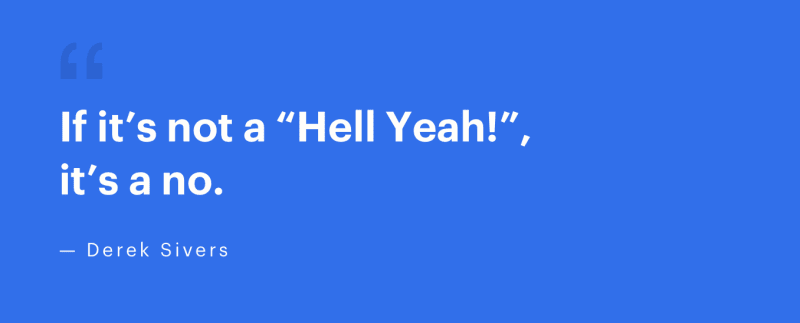
In the end, all interviewers must vouch strongly for the candidate as a great fit. We refer back to Derek Sivers’ No “yes.” Either “hell yeah” or “no.” mentality in making all hiring decisions.
We don’t have an exit plan. We want to build a company that outlives us. This is an ambitious goal, and we only stand a chance to realize it if we manage to hire people who truly believe in what we’re doing.
A sustainable, employee-centric vision
Once you’ve been successful in hiring smart, proactive people who are excited about the job they’re doing, one of the biggest challenges in adapting to remote work is knowing where to draw the line between work and life. When you’re in complete control of how you spend your time, it’s hard to ever feel like you’ve done enough. However, we strongly believe that to be a sustainable business, employees need to be able to have rich lives outside of work too.
We set the expectation from the get-go that no one should be working long hours or during the weekends. (Support is the exception to the rule, but they get equivalent time off after a weekend shift.)
Eight hours of effective work five days a week is more than enough to get everything done. We’re in the productivity business, after all. We enforce this rule strictly. It’s never acceptable to post an out-of-office notice to the team that includes any type of phrasing like “I’ll be mostly offline, but if needed you can reach me at xxx.” We have some pretty creative writers on the team who never fail to rephrase offending posts with a funny touch.
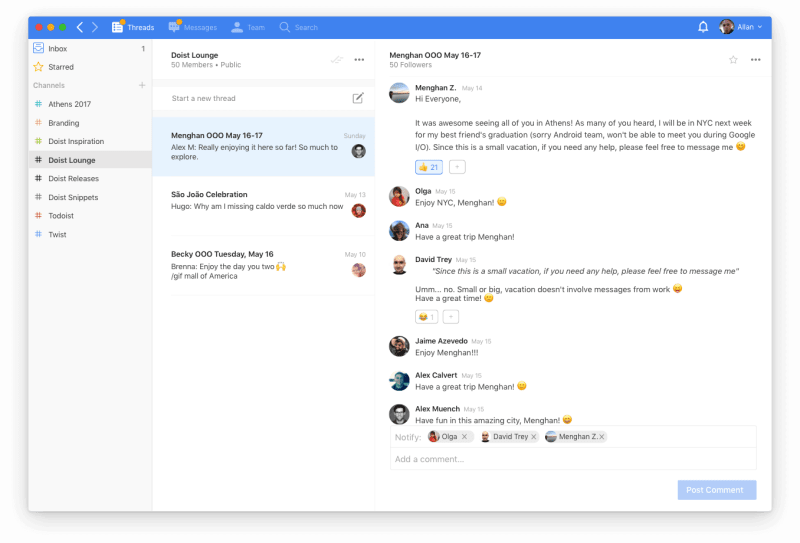
We’re all role models, and things like this can easily creep into the culture even if only a few people start breaking the rules. This means that if a team member responds to a message while they’re supposed to be off, the person is gently but firmly suggested to log the heck off.
To help hold ourselves accountable, we implemented a vacation mode feature in Twist, our team communication tool, so we can set ourselves as “away” ahead of time. While in vacation mode, all notifications are turned off and a special vacation avatar automatically replaces our normal one. It serves as a reminder for everyone to be mindful of their teammates’ time off and to know that if they do send a message, they shouldn’t expect a response until that person is back at work.
We’ve also tried to reflect a commitment to work-life balance in our employee perks. We need our team members to thrive for many years to come, and it’s important we all stay mentally and physically healthy. Some of the perks we offer to support this philosophy are:
Mandatory five weeks of paid vacation per year in addition to national holidays in your country of residence
Mandatory 18 weeks of paid maternity leave and five weeks of paid paternity and adoption leave
Flexible work schedule with no requirement to be online at any certain time
Work from the global location of your choice as long as there’s access to a stable internet connection
A coworking office of your choice for anyone who needs to get out of the house and be around people
Monthly reimbursement of exercise activities
Healthy snack stipend
Education stipend
Making sure the way we communicate aligns with our values
Perks are great, but they only go so far in building a unified, productive remote team. The true cornerstone of our company and culture and the reason we’ve been able to become a leader in an incredibly crowded market is the way we communicate.
Meetings are a rarity at Todoist. We have very few regular meetings and generally only schedule ad hoc ones when we feel that face-to-face communication is necessary to move a project forward.
Nowadays, the only time we use internal email is when a new team member is onboarded. Instead, 95% of our team communication is asynchronous as well as transparent and searchable (unlike email).
Keeping communication fully accessible to the whole team supports one of Todoist’s core beliefs. The best argument always wins, regardless of who you are, your title, or your seniority. It’s impossible to live by such a rule in a remote structure unless you have a centralized place with full transparency around what’s going on, including decision-making.
Learning from Slack
Before we built Twist, we used Slack. It was a great tool that was fun and easy-to-use (who doesn’t love a good GIF?). And it certainly helped us feel more like a team than disconnected individuals.
But it had other negative side effects. Keeping up with Slack conversations started consuming more and more time. People felt they had to be online constantly so they wouldn’t miss out on something important. This quickly became a glaring problem.
Individuals in outlying timezones and those who went offline for extended periods during the day to do deep work were excluded from conversations. The work-life balance we cared so deeply about was under immense pressure.
We realized that the kind of communication Slack was set up for didn’t support our values of clear communication, craftsmanship, balance, focus, and impact. We could see it was taking a toll on people. But when we looked for alternatives, it seemed that the whole market was following a similar real-time group chat model.
It was then that we decided to double down on the product development of Twist. After just four or five months, we moved the entire team and all of our company’s communication from Slack to Twist in one go.
At first, it was rough. I recall having calls with colleagues about how we felt Twist just didn’t do it for us. We were missing Slack and all its bells and whistles.
Today, the product has matured a lot, and I can honestly say that Twist has become the heartbeat of Todoist. Threaded communication keeps all our conversations organized by topic so a designer in Taiwan can catch up and contribute to a discussion that happened 10 hours ago during US work hours.
Work rarely happens outside of Twist, even in the small office we have for the contingent of six working from Porto, Portugal. Whenever issues are discussed offline or on calls, the outcome of these discussions is always shared with the relevant teammates on Twist.
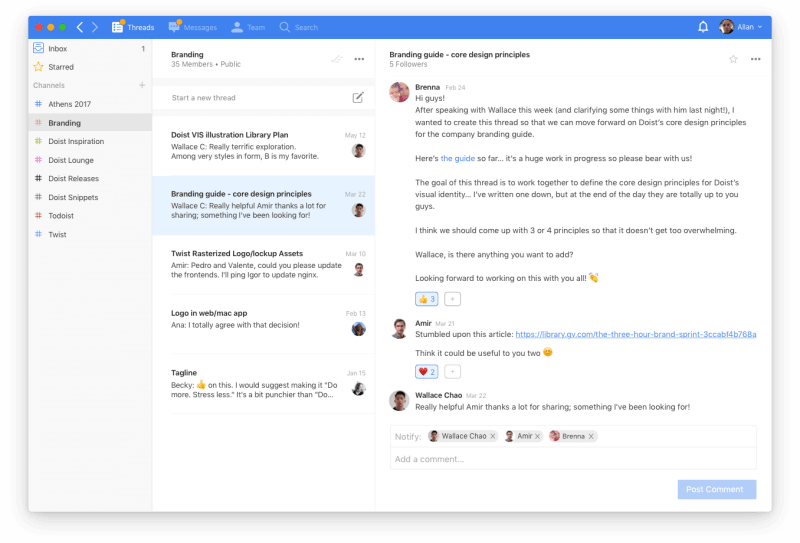
Remote first = Async first
Everyone at Todoist knows that asynchronous communication is the default, and no one should expect an immediate response from their teammates. This makes working with people in other time zones possible. It also gives people the freedom to disconnect, focus completely on their work, and come back to respond later.
In Twist, threads keep everything separated by topic so people don’t get left out of entire conversations because the group chat moved on to other things. It’s how we’re able to strike a balance between meaningful productivity and productive communication.
Transparent and accessible
The vast majority of our Twist channels are public, so even teammates who weren’t directly notified about a discussion can browse or search for the whole conversation. Because everything’s organized by topic, it’s easy for someone to search for the information they need and get all the context of the original conversation without having to wait on someone else who might be asleep halfway across the world.
This accessibility has also had an unintended benefit of making new employee onboarding incredibly easy. We just add new teammates to relevant Twist channels and they can browse at their leisure to learn more about specific topics.
They get to see exactly how we work together to get feedback, troubleshoot issues, and make decisions from start to finish. It’s been an awesome way to immerse new employees in how our company operates and for them to get up to speed on what’s currently going on without any added work on our end.
Of course, when anything in the conversation becomes actionable, we add a task or create a new project in Todoist with a link back to the original Twist thread for reference.
Team retreats
Since we don’t have what we consider a physical headquarters, we looked at what other companies did to bring people together. The outcome was to allocate money for twice yearly retreats to bring everybody together in one place and get to know each other better, bond, and have face-to-face discussions.
Over the years we’ve been to Menorca, Spain, Thailand, Iceland, Mexico, Austria, Italy, France, Ireland, etc. During retreats we spend a relatively small amount of time in formal work sessions. The rest of the time is for exploring the beautiful places we’re in and having impromptu conversations with people across teams.
Those retreats undoubtedly help bond the team together and reignite energy in what we’re working toward. But it’s just two weeks a year. Everything else we do throughout the year to live up to our professed values is much more important.
Current challenges and experimentation (aka growing pains)
As our team grew to 30 or 40 people, we started to feel the need for a system to keep everybody on the same page to maintain a high level of productivity. It got harder to follow what was going on and who was in charge of what.
Deadlines weren’t getting met (or even set in some cases). We had to ask ourselves how we could stay productive and grow the team at the same time.
Initially we tried to implement an objectives and key results (OKR) system similar to what Intel and Google use. But it didn’t go well. OKRs helped promote transparency, but they didn’t help us define exactly what projects would ship across which teams and when.
There was still no accountability to deadlines, and tracking and updating the system added a lot of overhead. And it didn’t provide a clear framework for people to align their individual work priorities when there were dependencies in projects across teams.
To try and solve that last problem, we attempted to adopt Spotify’s Engineering Culture System, which uses the concept of squads that consist of small, autonomous, cross-functional teams. That didn’t work super well out of the box either. Their system was optimized for teams located in the same office and for a large enough company where dedicated, multidisciplinary resources are available for each squad.
The DO system
Ultimately, we created our own hybrid of the two systems (goals and squads) in what we call the DO (Todoist Objective) System. The system focuses on output rather than outcomes.
Our quarterly goals consist of things we have full control over shipping. For example, one quarter 2 goal is to ship version one of the Todoist Help Center redesign.
We create a short-term, cross-functional squad for each DO. In the example above, a product marketer/copywriter, a designer, and a front-end developer. A squad leader is tasked with setting timelines and coordinating the project from start to finish. Each squad has a dedicated Todoist project to track tasks and deadlines and a Twist channel for high-level communication so there’s never a question of where to find the relevant information.
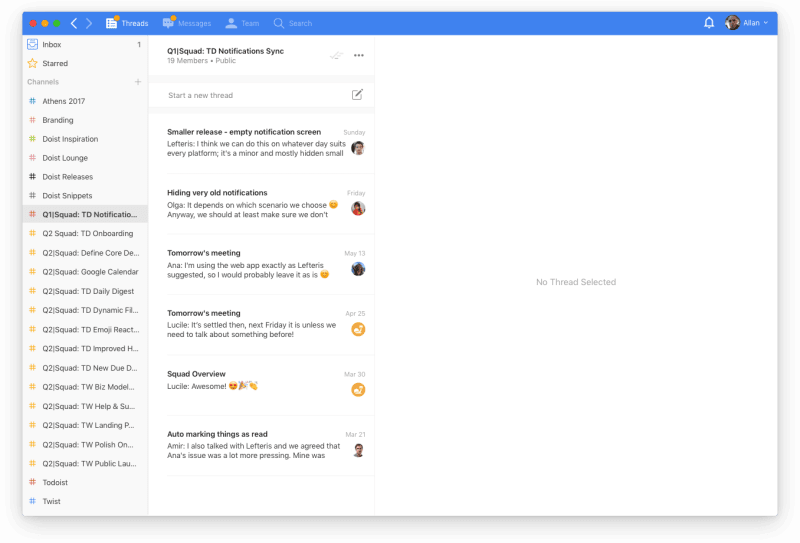
The DO system is a better fit for how we work. It’s light on process with a focus on shipping concrete things quickly. And it addresses the big issues we face in coordinating a larger team.
The whole company now knows which projects should receive the highest priority. We create temporary squads as needed and keep them small to minimize communication overhead. And there’s a single person responsible for setting and enforcing deadlines.
The future of work
We feel that we’ve managed to create a remote environment in which people can thrive, grow, and strike a healthy work-life balance.
We believe that remote work is the future, but companies (Todoist included) have a long way to go to develop all of the best practices and processes to support it. We’re excited to be a part of solving these problems and building the future we want to work in.
For us, Todoist isn’t just a product or platform. It represents a fundamentally different way of working and communicating that focuses on putting awesome things out into the world. If the way we work resonates with you, you may find that Todoist works for your team too. You can learn more about Todoist and try it for free.

Allan Christensen
COO, Todoist