
Resolution Hangover: How to Get Back on Track With Your New Year Resolutions After January
New Year’s resolutions get forgotten by the time February arrives. Make this year different. Here’s how.

New year resolutions after January can turn as soft as the wilted lettuce in the back of the fridge. They’re forgotten and stale, discovered again often at the end of the year with shame and regret.
Well, no more. This year’s gonna be different. No, I mean it. In this article, we will hammer down ways you can stick to your new year goals (or get back to them).
First: Figure out why you haven’t been able to stick to your resolutions
Figuring out why you haven’t been able to stick to your new year goals is the foundation to set yourself up for success. The reasons will help you gain insight into your future obstacles (and prevent them!). Once you've gained that clarity, the following actionable tactics unlock in a way that's much more useful. Don't skip this step.
Here are some of the common reasons you might’ve not stuck to your new year goals:
Your environment worked against you
You set too many and/or unrealistic goals
Your goals didn’t translate into an actionable plan
Your goal didn’t provide intrinsic meaning or fulfillment
You realized you just didn’t want to accomplish your goal badly enough
Or it might be something else entirely. Whatever it is, have a clear idea of why you lost motivation as the calendar turned a page. This will help you nip future problems in the bud and be more mindful of the obstacles coming your way.
10 actionable tips to achieve your New Year's goals
Beginnings (like a new year) provide us with the optimism of a fresh start. But as the beginnings transition into the middle, that enthusiasm fades. You need more than mere willpower and motivation to stack the deck in your favor. Here are ten actionable tactics that will help you do that:
1. Prepare yourself for the obstacles
The first exercise of jotting down why you haven’t made a dent in your resolutions will help you forecast obstacles when you restart your momentum.
Hear me out: It’s natural to lose motivation for your new year goals after a few weeks.
You get bored of the same old exercise routine 🥱
Your course to learn a new skill to upgrade your resume starts to feel like a drag 😩
If you expect the boredom and other obstacles to hit you, you can set up methods to work around it. Brainstorm all the obstructions likely to crop up in the process along with the fulfillment of achieving your goals. This method is called mental contrasting. Then, prepare a plan to overcome these challenges when they arise.
Let’s say your new year’s resolution is to delegate more in the office. Now, write:
Reasons you haven’t been able to achieve this goal in the past 🤔
New obstacles you might face in the future 😣
Perhaps the last time got chaotic because you didn’t have a proper system set up for delegating. So, this time, ensure you have workflows and documentation to eradicate this battle. Micromanaging might be a new challenge you might face, so prepare yourself mentally to let go of the reins when the time comes.
Common obstacles to achieving goals | How to avoid those obstacles |
|---|---|
Your environment didn’t support you (e.g. junk food in the pantry when you’re trying to eat healthy) | Set your environment up for success (keep loads of healthy and delicious snacks instead of the unhealthy ones) |
You set vague goals (e.g. "get a promotion" with no context or plan) | Devise an action plan to achieve your goals (understand the most important KPIs and how they can help you get a promotion) |
Your goals lost priority in your day-to-day life (e.g. you want to learn a language but stopped making time to continue learning) | Jot down small wins for the days you can dedicate only 10-20 mins to your goals (like 3 lessons on Duolingo) |
Preparing for obstacles not only relaxes your anxieties and equips you to handle challenges better but also makes you more flexible and able to stick with your goals when they get difficult (as they will surely do).
2. Do weekly reflections about your resolutions
I've been a big fan of the weekly review since I heard about it. The idea is simple: At the end of the week, you reflect on how your week went: what went right, what went wrong, what you could improve, and what you want from the upcoming week.
You can customize the prompts and choose any weekday to reflect, as long as you do it consistently. For example, I do my weekly reviews on Sundays, but many people prefer doing them on Fridays when the workweek ends.
In these weekly reviews, also examine how far along you are from accomplishing your new year goals. Here are some prompts that could help:
Did I do anything this week to achieve my resolution? If not, why?
What obstacles did I encounter this week while working on my objectives?
What could I do/improve next week to get closer to accomplishing my goals?
The worst thing you can do to your new year goals is...forget them. And yet, it happens. It’s easy to postpone working on your goals when you’re caught up in the day-to-day.
But a weekly review helps you get out of your own way. It keeps you accountable and ensures your resolutions remain top of mind. If you have moved the needle in accomplishing your goals, go celebrate! If you haven’t, dissect why and try to improve next week. Either way, there’s no ‘out of sight, out of mind’ problem with your resolutions anymore.
Instead of wondering why you haven’t achieved your resolutions every January 1, a weekly review gives you 52 chances to start fresh.
👉 Grab the weekly review template
3. Divide your goal’s milestones into quarters
Many workplaces set annual targets and then divide them into quarterly OKRs. You should do the same with your new year’s resolutions. Why? Because it fuels the dopamine reward cycle: If you set a year-long goal, the end is too far in sight to nudge you to take action today. But the sense of urgency stays higher if you have a quarterly milestone.
Let’s say your resolution is to expand your network. Break it down into quarterly OKRs. For example, by March, you must:
Attend 2 industry conferences
Do 4 virtual coffee chats
Help 3 new people
Having quarterly milestones will help you determine what you need to accomplish by March to achieve the full scale of your goal by December. It also gets less overwhelming when you break down the annual target into quarterly milestones.
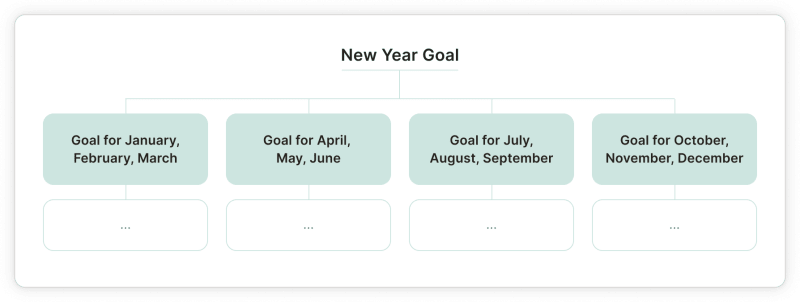
You can take this a step further by assigning yourself monthly goals, too. The best part? Quarterly check-ins like these also enable faster feedback loops. For instance, maybe you learned that industry conferences are seasonal in your location and need to be maxed out when they happen. So, for now, you can double down on virtual coffee chats.
Thanks to the quarterly goal (and check-in!), you could understand when something wasn’t working and adjust your approach quickly.
4. Celebrate small successes
I’ll be honest: There are a lot of rough days between ‘I hate doing this’ and ‘This is part of who I am now’ when you’re trying to accomplish any goal. Let’s say you want to start going to the gym three days a week. But it’ll take a lot of time and patience before:
You start enjoying going to the gym 💪
Going to the gym becomes second nature 🏋️
Initially, most goals require conscious effort and doing the thing even when you dislike doing it. It’s about fighting the inertia. Celebrating small successes eases the push needed to get started.
Set up positive reinforcements (aka rewards) for daily, monthly, and quarterly milestones. For example, my resolution was to post on LinkedIn at least three times a week. When I did, what’d I get?
1 post = 3 pieces of my favorite chocolate
Stuck to posting consistently for a month = Licence for ordering more jewelry I don’t need
Posted 32-36 times in a quarter = Permission to have an extra spa day in the upcoming month
I also used the habit tracker and noted my accomplishments as a part of my weekly review to give myself that extra feeling of victory. You can also jot down your wins daily while you get in the groove again.
If positive reinforcements don’t work for you, you can also set up negative reinforcements for behavioral change. For example: You can’t watch the new episode of your favorite show until you work toward your resolution.
Look, working on goals will become easier with time (when you continue taking action). But until then, keep the small wins in your back pocket to keep yourself motivated.
5. Convert your goals into actionable habits
Sometimes, your new year goals stay just ‘goals’ because you didn’t convert them into an actionable plan. For example, “improving my team’s morale” is a good goal, but:
It’s outcome-oriented: You can’t control all the factors that contribute to your team’s morale
It’s vague: The goal sounds good in theory, but it doesn’t tell you what exactly you need to do

First: Convert your outcome-oriented goal into a performance goal. This means you don’t frame a goal based on the outcome but on what you can control.
❌ improve team morale
✅ ask for feedback from employees every month
Next: Convert your vague goal into a SMART goal. Make it Specific, Measurable, Achievable, Relevant, and Time-bound. This will help you understand the tasks you need to do to achieve your goal. So, maybe you schedule a weekly check-in with every team member and run a satisfaction survey every quarter to collect feedback and measure your success.
The ultimate aim is to transform your goal into an actionable habit that you can do consistently, whether it’s daily or a few times a week. Instead of relying on memory (for the whole year!) to add these regular tasks to your to-do list, use Todoist to set up recurring tasks as easily as typing them out.
So, for instance, if you want to do a weekly progress check-in with the team every Thursday, just write, “Check-in with the team on progress every Thursday,” and Todoist will set it up as a recurring task

You need to know three things about the tasks that you need to do to accomplish your resolutions:
When will you do it?
Where will you do it?
How will you do it?
To continue the above example, someone who wants to improve team morale will speak to their team every Thursday about their weekly progress and overall satisfaction on a video call. You can layer more tasks related to your goals, but know the answers to the three questions above.
Start small and slowly increase the input required
If you’re struggling with adding a new habit to your routine, three things can help:
Reducing friction: As much as possible, reduce the friction you’ll experience before getting started (obstacle planning!). For instance, take out your gym clothes the night before if you want to hit the gym in the morning.
Habit stacking: Tack on your new habits before or after a habit you already have. For example, read right after brushing your teeth before bed. Soon enough, you’ll start to read after brushing on autopilot.
Temptation bundling: Pair something you enjoy with your new habit. For example, only listening to your favorite podcast while cooking a healthy meal.
Your resolutions seem overwhelming because they’re too big. And when something seems daunting, it’s easy to stay still. Converting your goals into a plan and your plan into daily/weekly habits ensures you take baby steps every day in the right direction.
6. Stop waiting for the right time, mood, or place
Here’s the thing: Sometimes, you don’t stick to the habits you’ve jotted down (and, by extension, don’t achieve your new year goals) because you’re stuck in your head. You conjure up a bundle of excuses: It’s not the right time, you’re not in the right mood, etc.
This is when the procrastination cycle begins. And before you know it, you feel you’ve dropped the ball, and you postpone the goal to next year.
The solution is simple, but not easy: Do the thing, even when you don’t want to. Don’t give yourself the time to think or talk yourself out of it. If it’s causing too much friction, fool yourself with, “I’ll do it only for five minutes,” and you’ll see that once you get into the flow, it’s easy to keep going.
You’ll not “feel like” doing the tough tasks in the beginning (hence bribing yourself with the small wins). Motivation is a flaky friend. But discipline? That’s the friend that’ll come through for you even when they’re exhausted to the bone.
And would you believe it: The more you fight yourself and take action even when you don’t ‘feel like’ it, the more it gets easier and your motivation increases. Win-win.
7. Find accountability partners
The most fun way to accomplish your new year goals is to do it alongside someone else. If you want to learn a new skill for work, for instance, find cohort courses where you can join a group of people working toward the same thing. Peers can help you stay accountable and also make the process more enjoyable.
You can also rely on your friends and family to help you stay accountable. For instance, I asked my friend to check in with me every week about how often I worked out that week. This helped me reflect, be honest with myself, and also have someone in my corner. Where’s the loss?
It’s not all imaginary: A study divided its participants into four groups:
Group 1 was asked to simply think about their goals
Group 2 was asked to write their goals
Group 3 was asked to write their goals and formulate action commitments
Group 4 was asked to write their goals, formulate action commitments, and send their goals to a supportive friend
Group 5 was asked to do all the above and send weekly reports to a supportive friend
Guess who achieved their goals to the closest degree at the end of four weeks? Group 5!
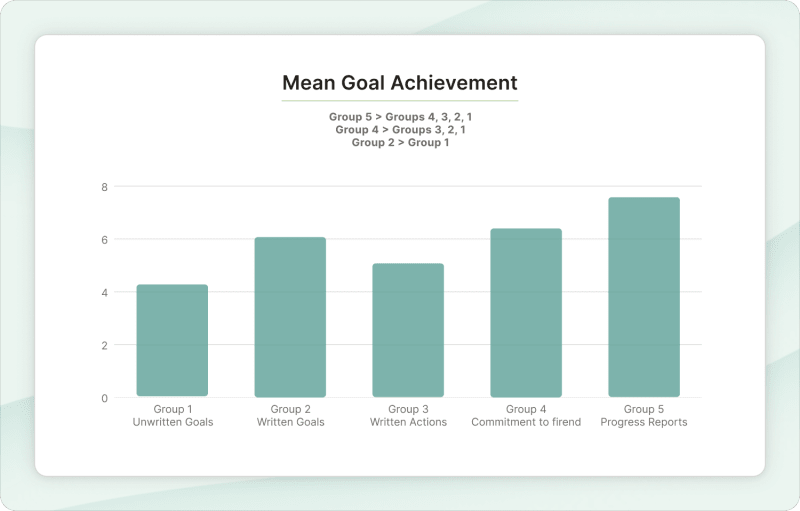
Bottom line: Join a club of people with the same goal as you, or simply ask someone to check in with you about your resolution every so often.
8. Set your goals using the MTO framework
The MTO framework is a goal-setting technique that moves beyond the binary of: You either achieved your goal or you didn’t. How? By setting three levels for every goal:
Minimum: This is the minimum progress you have to make based on your current skill level and past performance
Target: This is the target you should reach at the end of the year, slightly beyond what’s easy for you to accomplish
Outrageous: This is the progress that’s insurmountable, veering on the border of unrealistic and grandiose
Most new year goals are in the ‘outrageous’ category because of the relentless optimism infused at the beginning of the year. Assigning these levels ensures your feet stick to the ground and don’t get disappointed with yourself when you don’t meet your own unrealistic expectations. Because truly, if you meet your target, you’ve stretched yourself and can count it as a win.
Raymond Aaron (the creator of the MTO framework) gives an example of setting levels on the goal of ‘becoming the salesperson of the month’:
Minimum: Sell 7 units in the month
Target: Sell 9 units in the month
Outrageous: Become the salesperson of the month
He explains how the MTO framework will change your psychology and relationship to goals:
“You will most likely achieve your Minimum, since that is what you typically do. Maybe you attain 7 sales by the 22nd day of the month. You then look at your goal and realize that you’ve only got 2 sales to go to hit your Target. That will inspire you to go for it. If you achieve your Target then you are even happier; nevertheless, even if you hit only 7 or 8, you have still achieved your goal (at least to the Minimum), and you feel great. If you actually achieve Target, you are elated. And, the increased self-esteem you generate each month will soon propel you up into the Outrageous category.”
9. Attach your identity to your goals
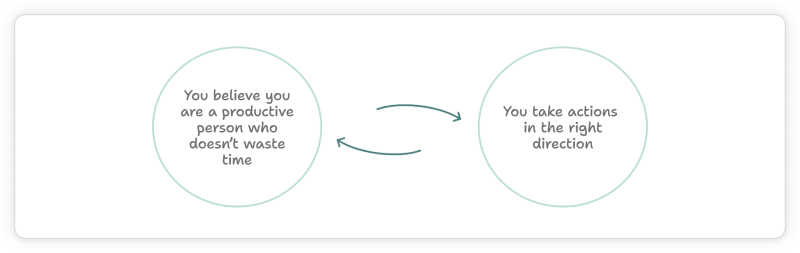
The most sticky form of behavioral change is forming your identity around your goal. For example, if you’re working on proper time management at work, yes, employ the practical techniques. But also start to see yourself as a ‘productive person who’s excellent at time management.’ This identity change propels a shift in your behavior in the desired direction.
It’s hard mindset work. What makes it easier? Taking action. The less time you waste, the easier it gets to convince yourself that you’re a productive person. But you can also start to inculcate these beliefs in yourself early on and use identity shifts to affect your behavior.
In Atomic Habits, James Clear shares there are three levels of change: outcome, process, and identity.
Wanting to change your outcome is when you want to change your results, like losing weight or increasing your income
Wanting to change your process is when you want to change your habits, like walking 10,000 steps every day or responding to emails daily
Wanting to change your identity is when you want to change your beliefs, like wanting to be a person who moves regularly or someone who takes workplace feedback like a champ

According to Clear, identity-driven changes are the strongest because they push you to challenge yourself at the cellular level. It leads to the deepest level of change, the one that lasts.
The book suggests working backward from your goals and asking yourself, “Who is the type of person that could get the outcome I want?” Begin from there and start to shift your identity, then your processes, and finally your results.
Don’t set outcome-based identity formations
10. Don’t be afraid to edit your resolutions
Were your goals realistic to begin with? Most new year resolutions are set in a ‘new year, new me,’ daze. But that self isn’t rooted in reality: It doesn’t remember your responsibilities, potential obstacles, and how to stick to goals when the going gets tough. That self is just daydreaming about what it will be like to achieve the goal minus the hard work.
Sometimes, your new year goals also need editing because of external factors. For example, one of my resolutions last year was to add a new service to my business. But with the AI wave, my current services took a turn and required me to level-up and change with the times, fast. My goals needed to shift because of industry changes, factors beyond my control.
If any of the above two has happened to you, you’re not alone. Your new year goals aren’t set in stone. Here’s your permission to change, adapt, or even discard your resolutions if your life needs it.
Resolutions carry a lot of pressure. So when people (expectedly) relapse into their old habits, they think, “Ah, better to give up now,” than “Let’s dust ourselves off and try again.”
Just because you couldn’t stick to your goals for the last two weeks of January or the first week of February doesn’t mean you can’t stick to them for the whole year. Relapses are learning opportunities to understand what prevents you from sticking to your goals. It’s not about how many times you fall off the wagon, it’s about how many times you dust yourself off and get back on.
Ultimately, the best way to achieve new year resolutions is to remember that the timeline is a tool, not a benchmark of success or failure. You can change whenever you want. How does today sound?

Rochi Zalani
Rochi is a writer covering productivity, SaaS, and the freelance lifestyle.