Todoist to menadżer zadań nr 1 na świecie, dzięki któremu zorganizujesz swoją pracę i życie. Dowiedz się więcej
You log in for the day, only to find 50+ new notifications. Where should you start: with your boss's DMs or those urgent client emails? What about that weekly standup you need to prepare for? And that time-sensitive project you haven't even started yet?
By 10 a.m., you've already burned through dozens of small decisions. Many might seem minor. But together, they drain your mental energy and take time away from the real work you need (and want) to do.
The Ivy Lee method can help by simplifying decision-making and keeping you focused. Hardly a new concept, this productivity method was first introduced in 1918. But even today, it remains a relevant and effective way to get clear on what's important, so you can concentrate on the work that matters to you.
What is the Ivy Lee method?
The Ivy Lee method is a daily planning system that helps you prioritize a shortlist of tasks you need to accomplish each day. It eliminates context switching and multitasking so you can get more done.
This productivity technique is named after Ivy Ledbetter Lee, a public relations consultant who developed it for a particularly demanding client: Charles Schwab, the president of one of America's largest steel companies.
The origin story: A $25,000 piece of advice
Obsessed with efficiency, Schwab wanted his executives at Bethlehem Steel Corporation to get more done. In 1918, he brought in Lee to help solve the problem.
Lee met with each of the executives, explaining his deceptively simple productivity method. Three months later, Schwab was so impressed with his executive team's increased productivity, he paid Lee $25,000 (worth over $500,000 today).
The 4 core rules of the Ivy Lee method
The Ivy Lee method follows four basic rules:
At the end of your day, identify six important tasks you need to do the next day. This number creates a constraint, forcing you to get clear on your priorities. It also limits you to a manageable number of tasks.
Rank tasks by priority and do them in order. If you could only finish one task tomorrow, which would it be? Order your task list from most important to least important. Then, work through them in that order.
Don't move on until the task is complete. The key to this method is working on one task at a time until it's finished. This approach helps you fully concentrate on what you're doing and avoid leaving tasks unfinished.
Move unfinished items to the next day's list. Each evening, look at what didn't get done and decide if it still matters. If it does, include it on tomorrow's list. This daily reset prevents old tasks from piling up.
Why the Ivy Lee method really works
This technique works so well because it helps overcome common blockers and avoid productivity traps.
Simplifies planning and limits distractions
The Ivy Lee method is one of the simplest productivity systems. In fact, some might argue that it's too simple. But if you've tried techniques that were too complex for your planning style, this one is worth trying.
If you're prone to distraction during the workday like I am, this method helps you hit the ground running in the morning and stay focused throughout the day. All you have to do is pick six tasks and work through them.
Just make sure you create your list the night before. Otherwise, you might get distracted by all the possibilities when you sit down to do the work.
Reduces decision fatigue
When you plan out your to-do list in advance, you have to make far fewer decisions during the workday. This reduces decision fatigue, which can otherwise deplete your energy and prevent you from getting started.
The toll that decision fatigue takes is real.
A 1998 study by Baumeister et al. found that making choices and self-regulation draw on the same inner resource. When this resource gets low, performance suffers.
A 2008 study by Vohs et al. found that making a high volume of choices lowers self-control levels. By actively looking forward to certain choices (e.g., your six daily tasks) you can reduce decision fatigue to an extent.
Eliminates multitasking
It's easy to convince yourself that if you just learned how to multitask, you could get more done. The problem? Multitasking is a myth.
What we call multitasking is really rapid task-switching, and it comes at a steep cost. A 2015 study by Mark et al. found that every time you switch tasks, it takes an average of 23 minutes to resume the task. If you frequently jump between tasks on your to-do list, you can see how quickly this time could add up.
Can't AI help? Not exactly. While AI tools don't truly help you multitask, they can speed up certain processes.
The Ivy Lee method prevents you from losing time to multitasking. You work on one task at a time to avoid context switching.
Avoids the trap of endless to-dos
I don't know about you, but my to-do list seems endless. It's filled with things I really need to do today, tasks that I need to start next month, bigger ideas that I might tackle in the future, and fragments of ideas that I may never start. If I use this list to plan my day, I get overwhelmed and stressed.
This happens partly because of the Zeigarnik effect. Essentially, your brain fixates on unfinished tasks, keeping them active in your mind even when you're not working on them.
So, when you have 50+ tasks on your list, that's 50+ things taking up mental space. The Ivy Lee method keeps this list to six items, reducing overwhelm and helping you feel like you have a handle on your day.
And when you successfully finish everything you set out to do in a day? You’ll feel immensely satisfied that you’ve completed your to-do list.
How to start using the Ivy Lee method today
The Ivy Lee method doesn't require any special tools or complicated setup. Here's how to get started.
Create your task list
Set aside 10-15 minutes at the end of your day to plan tomorrow. Look at everything on your plate: ongoing projects, new requests, things you've been putting off. From all that, choose six things to prioritize.
You can write down the six tasks on paper or add tasks in Todoist. Use the method that works best for you. What really matters is being intentional about what makes the cut and the order of importance.
Be honest about what you can accomplish in a day. If you're not sure how long something will take, overestimate rather than underestimate. You'll feel better finishing everything than getting partway through your list.
Take it from me, a person who chronically overestimates how much I can do in a day. When I'm realistic about what I can accomplish (and I actually get it done) I feel extra motivation to keep the streak going the next day.
Work through your list in order
When tomorrow arrives, open your list and start with task one. Do your best to work on it until it's done.
That means you should avoid checking email, responding to Slack messages, or doing anything else until that first task is complete.
If something genuinely urgent comes up, handle it. But then get back to your prioritized list. The trick is not letting the urgent take priority over the important.
Schedule daily review time
Before you wrap up for the day, review what you achieved. Did you finish your entire list? Did you have time for extra tasks? Move any unfinished tasks to the following day, and then build out your list.
It can be tempting to skip this session and just plan in the morning. But this method only works if you commit to the end-of-day review and planning session.
Otherwise, you'll find yourself back at square one: staring at an endless to-do list with no idea where to begin.
Adjust your list as necessary
Use your review sessions to inform how you approach your task list:
If you regularly finish your entire list early in the day, the tasks might not be as time-consuming as you thought. Consider adding bigger tasks to your list for future days.
If you tend to complete part of your list, the tasks might be bigger than you thought. Or maybe frequent interruptions throw off your schedule. Pay attention to where your time goes throughout the day.
Use Todoist to make the Ivy Lee method easier
While you can certainly use the Ivy Lee method with pen and paper, Todoist can make the system easier to maintain and more powerful to use.
Focus on your top 6 tasks with the Today view
Keep all tasks that aren't on your daily list out of sight and out of mind with Todoist's Today view. This is helpful if you can consistently keep your daily schedule to only your top six tasks.

If you work with a team or if your Today view tends to have a lot of extra tasks, use the other methods below.
Apply priorities to reinforce the task order
Use Todoist's priority levels to rank your six tasks. Your most important task gets p1 (red), the next get p2 (orange), and the others get p3 (blue).
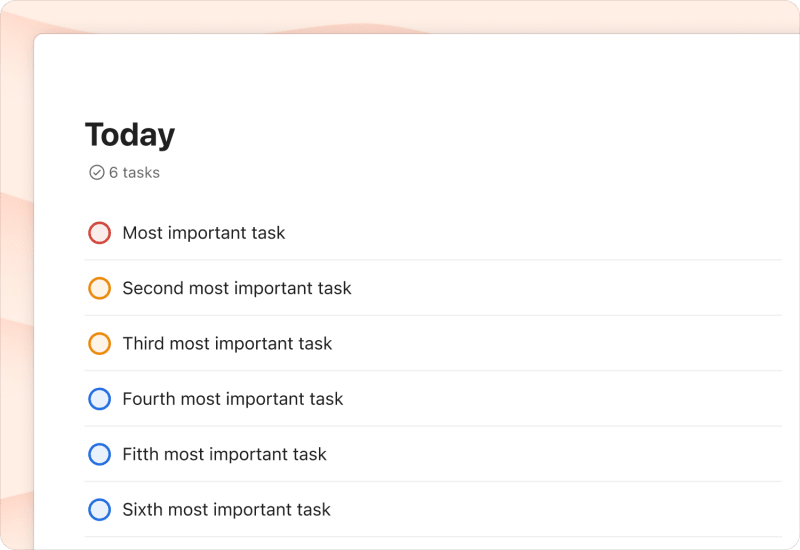
This visual hierarchy reinforces the order and makes it immediately obvious which task deserves your attention right now. Sort the Today view by priority so your most important work always appears at the top.
Use labels to group and revisit
If your to-do list tends to include a mix of tasks (e.g., your daily six, team projects and less important tasks) use labels to keep everything organized. Create a label like @Ivy Lee.
This makes it easy to see your daily six at a glance, even if your Today view includes other items. Plus, you can click to view all items labeled Ivy Lee so you can go into focus mode with your daily tasks.

Repeat tasks via recurring scheduling
Use recurring tasks to ensure you never forget your daily planning and review session. In Todoist, set a recurring task to plan the next day's list. Schedule it for the end of your workday. Say, 4:45 p.m., if you typically finish at 5 p.m.

When you check off the task, it will automatically move to the next day.
Track completion streaks to build habits
Update Todoist's productivity settings to reflect the number of tasks you want to complete in a day or week. For example, with the Ivy Lee method, you'll likely aim for six tasks per day. Make sure to set your days off (e.g., Saturday and Sunday).

Todoist will automatically track whether you hit your goal each day and show your completion streak. This is a great way to build momentum.
How to make the Ivy Lee method work for you
The Ivy Lee method pairs well with a variety of work situations and productivity preferences. Here are a few ideas to make this method work better for you.
Adapting to team workflows
If you're on a team, the Ivy Lee method can still work. The catch is that you need to account for your team's priorities. So, your task list might include "Review and respond to team feedback on proposal" or "30-minute meeting with Sarah about Q4 planning."
Be realistic about how much solo work you can do when you have meetings and collaborative projects to do. Your six tasks will look different on a day with three hours of meetings versus an empty calendar.
Pairing with time blocking
The Ivy Lee method tells you what to work on and in what order. Time blocking tells you when. For me, combining the two is the perfect time management tool.
I estimate how long each task will take as I make and rank my list. Then, I block out time for everything using Todoist's calendar layout.

This is helpful for two reasons:
I can plan to do my most important task at my peak productivity time (for me, that's early afternoon) instead of feeling like I have to do it first.
I know exactly what I'm going to do the moment I start work, so I don't have to make any decisions at the beginning of the day.
Combining it with Pomodoro
If you struggle with focus even when you've limited yourself to one task, try combining the Ivy Lee method with the Pomodoro technique.
Work on your current task for 25 minutes, take a 5-minute break, then continue. The timer gives you a concrete endpoint to aim for, which can make it easier to resist distractions.
Using it weekly instead of daily
If daily planning feels like too much overhead, or if you have longer-term projects where finishing a task might take multiple days, skip the daily list. Try planning weekly instead.
On Sunday evening, identify your six most important tasks for the week. Rank them, then work through them in order. Once you finish task one, move to task two, regardless of what day it is.
Trying the 3-2-1 variation
When your days are filled with meetings, team projects, and unexpected tasks, getting through your list of six tasks every day might be impossible.
Instead of aiming to complete six tasks, try a 3-2-1 variation: three must-do tasks, two should-do tasks, and one nice-to-do task.
Focus on your must-do items first. If you get through those, tackle your should-dos. The nice-to-do item is a bonus if you have time and energy left over.
More than a century after Ivy Lee first proposed this simple method, it remains popular because it solves a fundamental problem: We have limited time and unlimited things we could do with it.
By forcing you to choose just six tasks, rank them in order of importance, and work through them without distraction, the method cuts through the noise and keeps you focused on what really matters.
The best way to know if this technique works for you is to try it. Before you finish work today, write down six tasks for tomorrow, and then work through them.
Try it for a week and see what happens to your focus. You might be surprised by how much clearer your days feel when your to-do list stays manageable and you're not constantly deciding what to work on next.

Anna Sonnenberg
Anna Sonnenberg is a writer, editor, and strategist with over a decade of experience creating content for B2B SaaS companies like Agorapulse, Komodo, and Relato. As a seasoned freelancer managing a dynamic client roster, she's always testing productivity and time management tactics.