Why the Future of Work is Remote
The founder of Todoist on why the future of work is remote, and what that could mean for tomorrow’s workers, companies, and communities.
In 2015, we held our very first team retreat on the small Mediterranean island of Menorca. Of the 28 team members who attended the retreat, I had only met 14 in person. Fast forward to 2026, and we are 100 people, spread across 40 different countries. There are still people on the team who have worked for the company for many years whom I have never met in person.
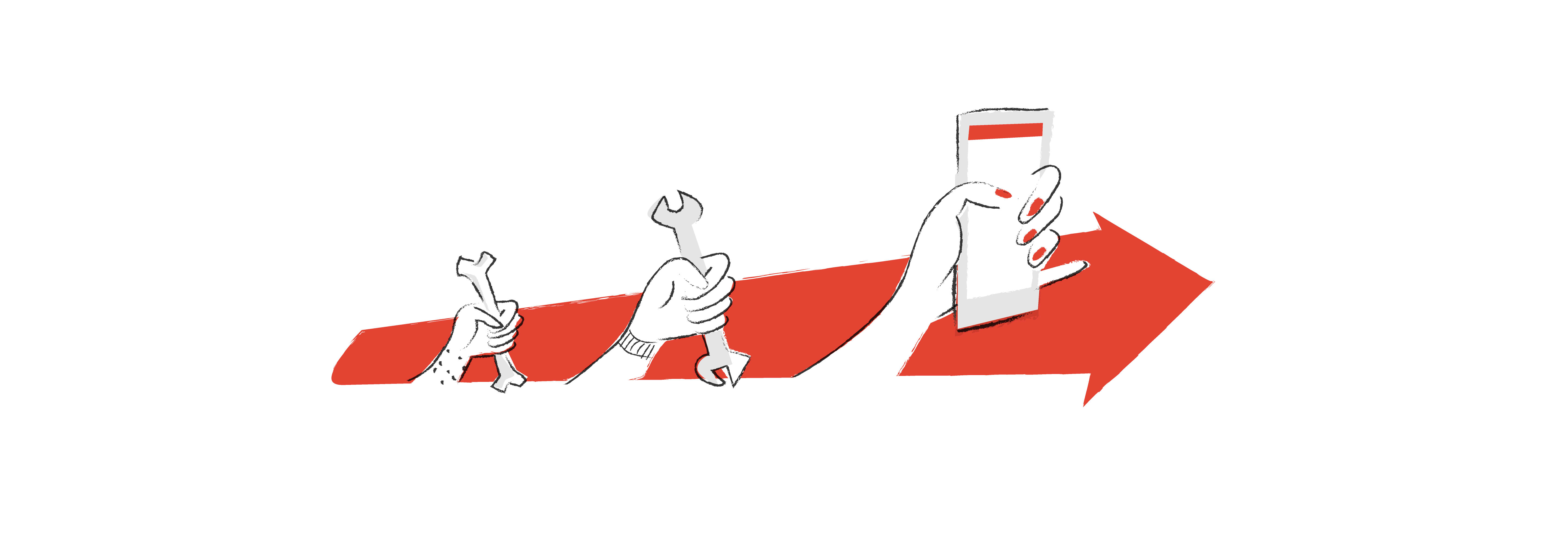
Just 20 years ago, this style of working would have been impossible. But today, more and more teams are discovering the benefits of a remote-first workplace where anyone can collaborate with anyone else from anywhere in the world. This post is a reflection on why the remote-first movement could represent a massive paradigm shift with widespread implications for the world, similar to industrialization.

1/ Remote-first working could be a paradigm shift similar to the industrialization age
Remote work has become the new normal. Read our online handbook, Remote Setup: The Remote Guide to Logistics, to learn how your company can approach incorporation, taxes, and hiring to join the distributed revolution.
The way we work is the way we live
Before we get to what remote-first is and why it’s so important, let’s take a brief walk through the history of work and how the way we make a living can change just about everything.
Prehistoric humans were hunters and gatherers who roamed around following their food sources with no fixed address. Yes, lives were generally short, but nomadic societies were relatively equitable. People formed tight-knit communities to survive and were, of course, much more connected to the environment they lived in.
The eventual move to farming offered a few obvious benefits. Agriculture gave us the stability to start building civilizations. Bigger settlements and eventually cities were established. Trade became a thing. Lifespans and populations increased.
But agriculture also made us much less connected to nature, restricted our diets, left us more reliant on a smaller number of crops, and allowed for the concept of personal property to come into existence. Society became divided between the haves and the have nots.
Unlike nomadic hunters and gatherers, location was critical for farmers. Most people didn’t move far away from where they were born.
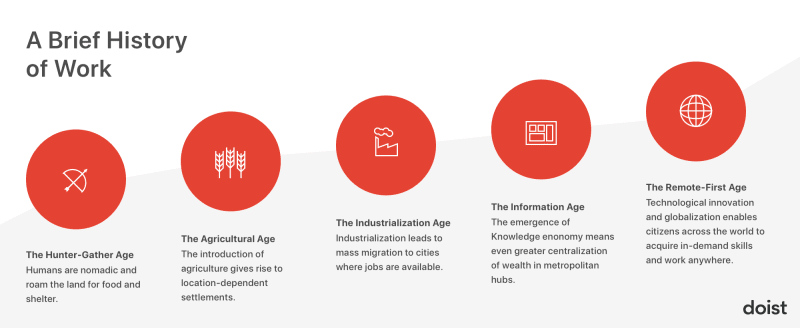
Fast forward thousands of years to the next big historical shake-up in work: the Industrial Revolution. Farmers left the countryside and followed factory jobs to the cities. Factory wage work was arguably even more stable than farming.
When you work in a factory, you don’t have to worry about locusts or hail damage or drought or floods or any of the other creative ways nature can kill your crops. But there’s a reason you probably associate industrialization with lonely, exploited laborers living in grey, smog-choked, overcrowded cities.
Importantly for our story, getting a job meant living near a factory. Families and rural communities became less stable as people concentrated in urban areas like London and New York.
Eventually, things like labor unions improved the quality of life for industrial workers. But then technological innovation went and ripped the rug out from everyone’s feet. Again. New, revolutionary things like the computer and the Internet ushered in what we’re now living through: the Information Age.
What work looks like today
Today, work is increasingly synonymous with sitting in front of a computer for eight hours (or more) a day. We call people with this kind of job knowledge workers, and they’re mostly paid to do things like thinking and creative problem-solving. Factory jobs and manual labor are increasingly automated by increasingly sophisticated technology.
To get a good job, knowledge workers still have to live in even larger cities where pollution, overpopulation, traffic, and cost of living are all increasingly (de)pressing issues. The rising cost of living in urban centers like New York, Beijing, London, and San Francisco means that many people can’t afford a good quality of life.
To add insult to injury, it’s not uncommon to spend over two hours a day just traveling to and from work. In the article A 2:15 Alarm, 2 Trains and a Bus Get Her to Work by 7 a.m., the New York Times chronicled the brutal commute of one San Francisco office worker who could no longer afford to live anywhere near her workplace.
Meanwhile, former industrial areas and rural communities are left economically and socially decimated. The conventional wisdom is that this growing economic gulf between rural and urban areas led to Trump’s election as President of the United States as well as Britain’s vote to exit the European Union.
What could work look like tomorrow?
From that brief look at the history of work, it’s clear that the type of job we do has enormous implications for pretty much everything else, from culture and wealth distribution to politics and society. We’re now on the cusp of what I believe could be another world-changing shift in the way we work.
Today, people from all of the regions of the world can quickly and cheaply connect online, making it easy to share ideas, learn new skills, and get inspired by others. Cloud-based technology that we now take for granted, like video calls and collaborative documents, didn’t exist just 20 years ago. We now have the infrastructure and tools to collaborate from anywhere there’s internet.
It’s never been cheaper to travel. For example, for a recent team retreat, we flew over 70 people from around the world to Thailand. Even as a completely bootstrapped and remote-first company, we can afford to meet up and get to know one another in person. This would’ve been too expensive 20 years ago.
In the last 10 to 20 years, online banking has become sophisticated enough for individuals to send and receive money from anywhere in the world. Some countries are removing the vast majority of physical banks altogether.
All of these changes are creating a new paradigm of work: remote-first.
What is remote-first exactly? It’s the most extreme version of remote work. It’s not just working from home on Fridays or having a few telecommuting employees connect to a conference call while everyone else gathers in a meeting room.
At Todoist, remote-first looks like this:
All processes inside the company, including product development, marketing, customer support, human resources, and everything in between, are fully distributed around the world.
There’s no preference toward hiring from any particular region or time zone, except for support roles where we want to make sure we have coverage 24/7.
We primarily use tools and methods that are asynchronous. When I send a message to a teammate, I never expect an immediate response. This lets us work when it suits us best in our respective time zones without required work hours.
There’s no single headquarters where things are centralized.
Joel from Buffer, another remote-first company, has written an article on the 5 Varieties of Remote Working in Companies, which goes deeper into the different types of remote working structures.
Why is the shift toward remote-first so significant? Previously, all jobs required people to live close to their places of work. Even nomadic hunter-gatherers had to go where the food was. Remote-first is the first way of working that is truly location-independent. This change has huge potential benefits not just for individuals and companies, but for the world.
The benefits of remote-first work
Revitalizing local communities
Remote-first work means that, for the first time in human history, people can access tremendous career opportunities and high-paying jobs regardless of where they live.
For some, this means roaming the world, exploring different cities and cultures, and living the so-called digital nomad lifestyle. For others, it means staying in their local community surrounded by family members and long-time friends.
As an example, Enric, an iOS developer on our team, has lived his whole life on the small, beautiful island of Menorca off the coast of Spain. Before remote-first companies were possible, Enric would most likely have had to relocate to a bigger city to get a job as an iOS developer.
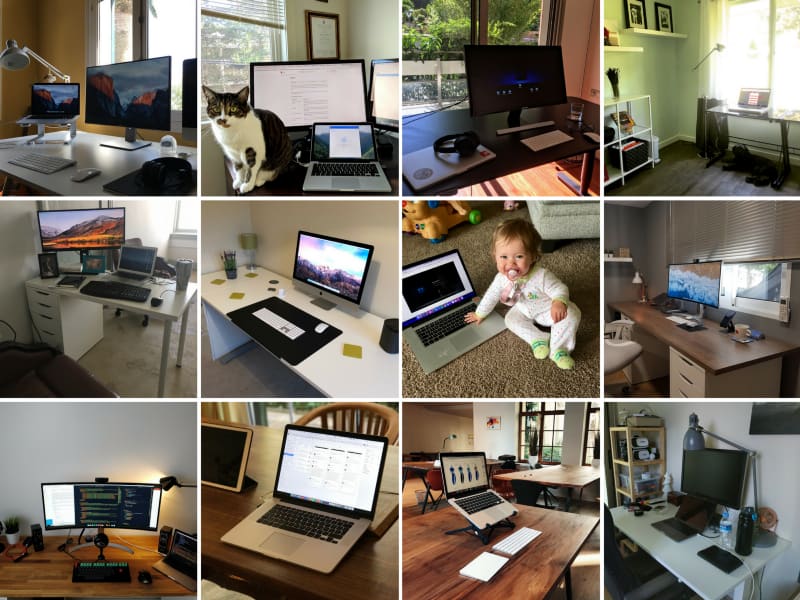
Todoist home offices from around the globe
As remote-first work becomes more and more common, people like Enric can choose to stay in their hometowns without giving up access to fulfilling, stable jobs. In that way, remote work has the potential to keep dollars and young people in communities and countries that have been left behind in the information age. A more equal geographic distribution of wealth would have widespread political, economic, and social impact that we can only begin to imagine.
Giving small companies a chance
When I made Todoist’s first hire, I was living in Santiago, Chile. Todoist was a simple web app with a few thousand users. It was incredibly hard to find the kind of local tech talent I needed to grow the business. So I made my first hire in customer support on Elance.
Todoist has been a remote-first company ever since. We’ve been able to find amazing people from around the world without competing against hundreds of other companies in the same tech hub. There’s no way Todoist could be bootstrapped, independent, and profitable from day one if we had to compete in Silicon Valley.
Currently, we’re in a world dominated by a few tech giants. For new companies, the ability to source talent from anywhere in the world is a substantial competitive advantage. Remote-first can give small, innovative businesses room to experiment, grow, and become viable without being dependent on a small number of investors who hold the keys to the tech kingdom.
Entrepreneurs can test their ideas from anywhere in the world without uprooting their lives or spending their savings trying to make it in Silicon Valley. It’s another way that remote-first work could tip the scales away from the current centralization of wealth and power.
Promoting real diversity and global citizens
Real diversity doesn’t come from hiring people from a few cosmopolitan hubs. People who live in London, for example, are likely to share many of the same experiences and worldviews, even if they differ in gender, sexual orientation, or religion. If the rural-urban divides that fueled Brexit and the most recent US presidential election are any indication, metropolitan areas create cultural bubbles.
Remote-first offers the potential for true diversity. You can hire people from very different cultures who provide unique outlooks on the world. This type of diversity has been a huge competitive advantage for our company. It has allowed us to build services for global markets, not just for the US or Europe. But the benefits of a workforce from around the world go beyond the company level.
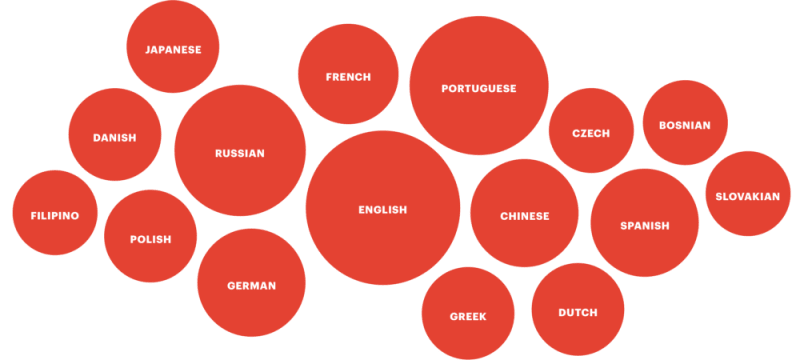
Todoist’s native languages
In recent years, we’ve seen an alarming rise in divisive, nationalistic rhetoric in many parts of the world. Globalization hasn’t always meant closer connections between people from different cultures.
At Todoist, we go to work every day with people from almost every continent. We share and learn from our different perspectives and form lasting friendships. When we hear about international tragedies in the news, both manmade and natural, we jump online to see if our teammates and their families are safe. Those tragedies no longer feel half a world away.
The world faces huge global challenges, from climate change to terrorism to the refugee crisis. If we’re going to find solutions together, we need a shared understanding of what it means to be a global citizen. Remote-first teams can be a vehicle for creating those important personal connections across borders.
Supporting work-life balance and closing the gender gap
You might expect a lack of in-person interaction to create weak connections and low employee retention rates. We see the exact opposite. We have excellent employee retention (with over 20% of Todoist team members currently at 10 years plus), which tells us that people are happy and place a lot of value on the flexibility that a remote-first work setting provides.
In addition to being the CEO of the company, I’m also a dad. Balancing work and life has never been more critical. Brenna, our head of marketing and the mother of two, has written a fantastic article about remote work and parenting. Personally, a remote-first workplace allows me to continue to lead the company and spend quality time with my family every day:
I don’t have to be working at any specific times, so I can spend a few hours in the morning with the kids without worrying about having to clock in online (or at an office).
I can drop work and come home early to deal with anything unexpected without affecting the work of others, given we work asynchronously by default anyway.
This kind of flexibility to pursue ambitious professional goals without sacrificing family and personal life illustrates why people feel fulfilled in a remote-first environment. It also has the potential to promote greater gender equality in the workplace.
It’s 2026, and women still have to choose between having a career and having a family. Studies show that in most wealthy countries, women’s employment falls by roughly 20–30% when they have children. But there’s a practical solution. Research has shown that greater flexibility in work hours and location significantly decreases work-family conflicts and employee turnover.
And according to a Pew survey, 71% of working parents say having a flexible work schedule is extremely important to them. By allowing women to control their own schedules, remote-first work has the potential to significantly close the gender gap in business.
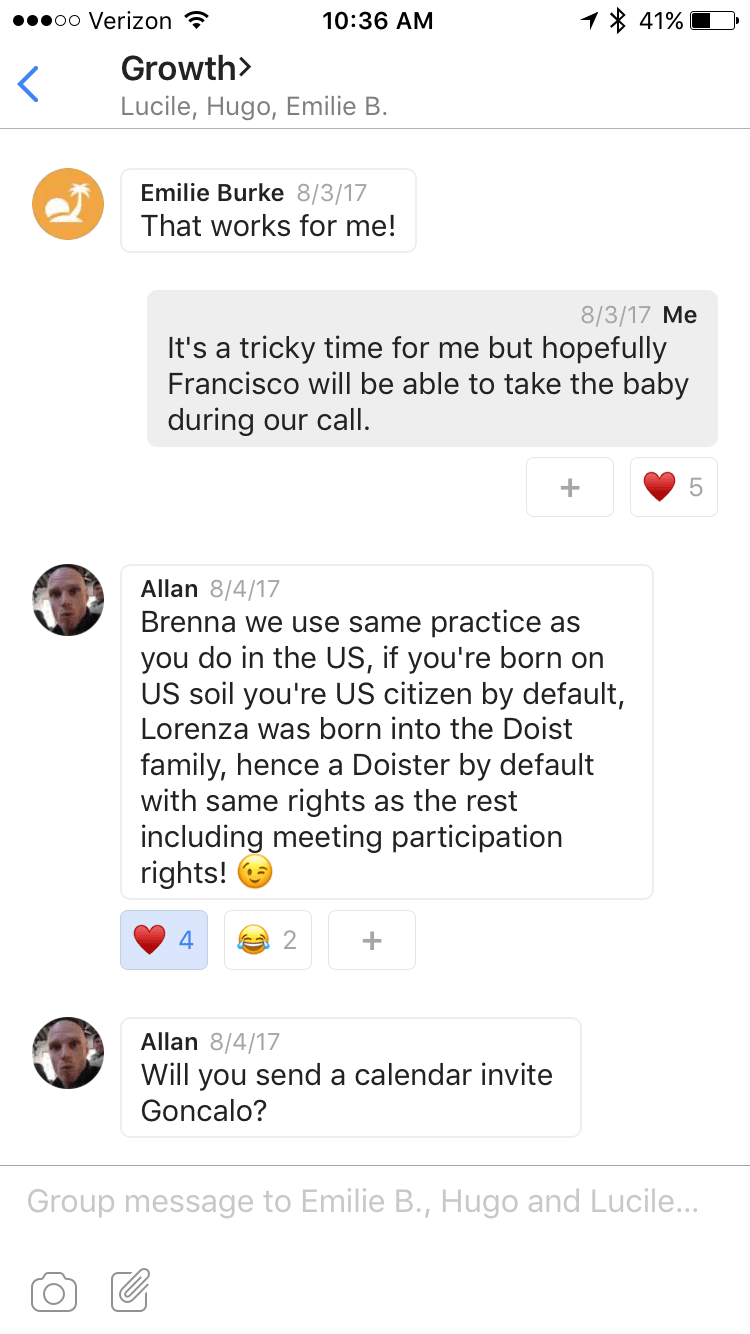
Research has shown that greater flexibility in work hours and location significantly decreases work-family conflicts and employee turnover.
But is remote work as effective?
One of the common questions I get about remote-first work is whether virtual collaboration can really replace face-to-face interaction. Is it possible to work remotely and have the same level of innovation and human connection that supposedly only arises from serendipitous office interactions?
Many of today’s work processes are predicated on everyone being in the same physical location. Of course, those same processes aren’t going to work in a remote setting. It requires new workflows and management strategies, uniquely adapted to this new way of working.
Remote companies have begun to share the lessons they’ve learned in building products and growing teams across vast distances. At Todoist, we’ve had our fair share of growing pains. We’ve had to figure out how to run operations, build a strong team culture, set a high-level vision, manage complex projects, hire the right people, onboard new team members, and resolve interpersonal issues, all while communicating asynchronously across ten different time zones. We’re still learning.
Remote companies are actively building a body of management knowledge that traditional companies have had decades to accumulate. But we’re already seeing the positive impact of these kinds of management innovations.
The New York Times reported on the findings of a Gallup poll done in both 2012 and 2016:
In 2012, workers who said they felt most engaged while working remotely were those who spent the least amount of time off-site. By 2016, that was no longer true. Workers who spend none or all of their time out of the office reported feeling equally engaged last year.
By 2025, the pattern flipped as Gallup’s data showed that fully remote workers were the most engaged group. Nearly a third (31%) of remote workers were engaged, compared to 19% of on-site workers.
Yes, remote-first poses unique challenges for team collaboration. But our team proves every day that it’s possible to build strong team culture and connections despite the physical distance between us.
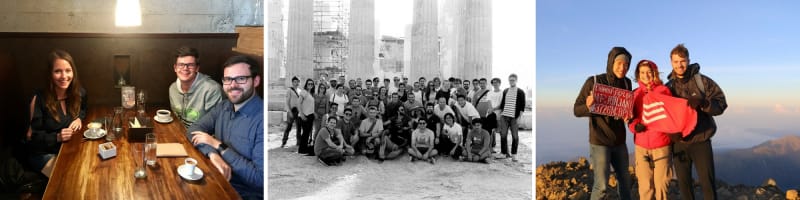
Todoisters meeting up around the world. From left to right: Brenna (Head of Marketing), Jan (Head of Windows), and Alex (Design) meeting for coffee in Seattle. The 2017 Todoist team retreat in Athens. Wallace (Design), Lucile (Growth), and Hugo (Growth) at the top of Mount Rinjani in Indonesia.
With remote-first work, we can decentralize wealth and build stronger local communities. We can also create space for innovative businesses to grow, advance what it means to be a global citizen in today’s world, support the work-life balance that is desperately lacking in so many industries, and help close the gender gap.
We’ll continue to see innovation in this space from companies, financial institutions, and governments that will help remote-first workplaces thrive. I personally can’t wait to see what that future will look like.

Amir Salihefendic
Amir Salihefendic is the founder and CEO of Todoist. He writes about productivity, remote work, async communication, and the lessons of building a distributed team for nearly two decades.