Taking Breaks the Right Way: How to Rest Without Derailing Your Day
Breaks can boost focus, reduce fatigue, and prevent burnout if you take them right. Learn how to take breaks during the workday that help (not hurt) your productivity.

It’s tempting to mistake long working hours for increased productivity. After all, if I’m powering through breaks, exhaustion, and bone-tired eyes, am I not getting more done?
Turns out, taking breaks in your workday is not just important, it’s essential. Think of it like sharpening an axe: if you keep chopping without stopping, the axe will get dull and you’ll make less progress with each swing. But if you pause and sharpen the blade, the axe becomes more effective.
It looks simple on the surface, but taking adequate breaks is surprisingly tricky business. How often should you take breaks? How long should you take a break for? How do you adapt breaks to your ever-evolving responsibilities? And what if you end up wasting more time than intended while you’re on a break?
If you struggle with all of these questions, you’re far from alone. In this guide, I’ll help you find some method to the madness so you can take breaks that leave you feeling refreshed without derailing your day.
Why you need to take frequent breaks during a workday
Breaks don’t just feel good, they actually make you more productive and healthy. Multiple studies have confirmed that:
Brief mental breaks can help you maintain your focus on a task for longer
Taking frequent short breaks will leave you feeling less fatigued and more energetic at the end of a workday
Frequent short breaks reduce overall physical strain (especially around your back and neck)
Taking breaks improves your work-life balance, overall satisfaction, and ability to manage stress
“The biggest misconception is that breaks are a reward for productivity, rather than a requirement for it. People often feel guilty stepping away from their work, especially in our hustle-oriented cultures that glorify constant output,” says Dr. Emily Anhalt, clinical psychologist and founder of Coa.
“But rest isn’t the opposite of work, it’s part of how our brains consolidate learning, stay emotionally regulated, and generate insight. I think we cling to the “push through” mentality because it gives us the illusion of control. But ironically, it’s rest that gives us real creative leverage.”
Despite the well-known benefits of taking breaks, a Slack study of 10,000 desk workers found that 50% of participants never or rarely take breaks during a workday. These workers are almost twice as likely to experience burnout.
Another survey of 1,000 workers by ezCater found that one in 10 people never take a lunch break, despite 78% of participants stating that a lunch break improves their job performance.
Which begs the question: Why do so many of us struggle to take breaks?
Why you (and I) struggle to take breaks
For the longest time, I viewed breaks as an obstacle in my workday. That's because once I finally paused working (usually after three hours or more) and took a break, I’d spend that hour wasting my time.
Looking back, the flaws in my thinking were obvious:
I thought skipping breaks would help me get through my to-do list faster.
I kept going until there was no fuel left in my engine.
I doomscrolled or did chores I couldn’t delay.
Maybe you, too, struggle with one or a combination of the above mental blocks. You can navigate and overcome them by establishing better systems tailored to your work responsibilities and lifestyle, which we will dig into in this article.
However, I want to acknowledge that not all issues related to taking breaks are internal. Sometimes, they’re systemic.
Surveys have revealed that people feel stepping away from work will make them appear lazy or unproductive, especially in ‘always-on’ work cultures.
The same survey also found that people feel discouraged to take a break if their managers don’t model the behavior.
Research has also discovered a high workload paradox where you don’t take breaks because you have too much to do, despite needing it more.
Office spaces might also lack private and comfortable spaces to allow people to rest and recharge.
The issues at the organizational level are hard to tackle alone. If you are struggling to take breaks due to them, it’s worth discussing with your manager.
Here’s the good news: There’s still a lot you can do, even within less-than-perfect organizational structures. You might not be able to fix the system overnight, but you can reclaim control over your own break habits. The following sections break down how to take better breaks and make them work for you, not against you.
How to take breaks without derailing your focus
To build a break-taking system for yourself, you need to answer three questions:
When should you take a break and for how long?
What activities should you do when you’re on a break?
How do you ensure you take sustainable breaks every workday?
There’s no one-size-fits-all answer to any of the questions. But, by reflecting on what works for your personality and responsibilities, you can design a routine that feels easy, natural, and realistic.
1. Find your best work-break ratio
The first question: When should you take a break and for how long?
I clubbed these two questions into one because they’re interdependent. If you’re taking a break after working for one hour, you need a longer break than if you were working for 20 minutes.
Now, there are various time-blocking ratios you can experiment with to find your best work-break rhythm.
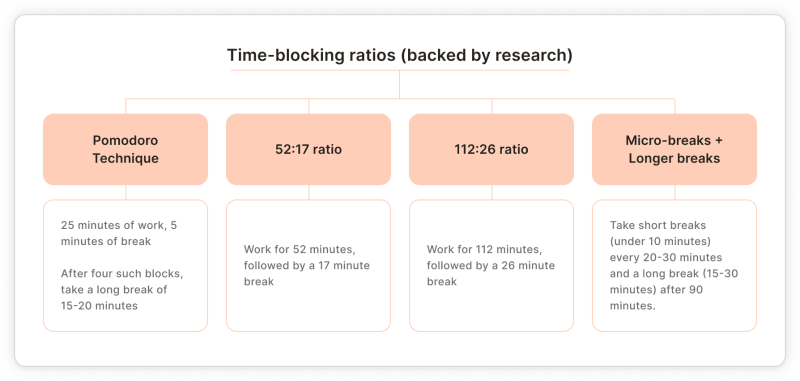
The pomodoro technique involves working in 25-minute blocks, followed by a five-minute break. After four such blocks, you take a long break of 15-20 minutes.
A study by DeskTime monitoring high performers found that employees in the top 10% productivity bracket worked for 52 minutes, then took a 17 minute break. Specific.
DeskTime updated this study in 2021 (to understand how the pandemic had shifted our habits) and identified a new ratio: 112 minutes of work followed by 26 minutes of break.
A meta-analysis of 22 studies found taking micro-breaks (under 10 minutes) every 20–30 minutes, along with longer breaks (15–30 minutes) every 90 minutes improved focus and decreased fatigue.
All these studies are suggestions that you must adapt to your own needs. Your best work-break ratio will depend on various factors, including:
Your natural rhythm: If you’re more productive at a certain time during the day, it might make more sense to work longer stretches with fewer breaks. For example, I know I’m more productive in the mornings and less so in the late afternoon. So, I work in 90 minute blocks followed by a 15 minute break in the mornings. In the afternoons, I dabble between Pomodoro and 52:17 work-break ratio, depending on my energy levels and the job I need to do.
The intensity of the task at hand:Some tasks (like getting to inbox zero) require less cognitive load than others (like writing or conducting a presentation meeting). The more intensive the task, the longer the break you’ll need.
Other responsibilities: Sometimes, you can’t afford to choose your own work-break ratio. Maybe your dog is sick, and you need to care for him for a few days. Perhaps an unexpected meeting came up that you can’t decline. Or your workplace decides your breaks for you. In such scenarios, you need to adjust your work-break ratio to accommodate your unavoidable duties.
How do you determine when you need a break?
There’s no single ‘right’ work-break ratio. No magical alarm will tell you when to pause. You need to adapt your work-break ratio based on your task, individual preferences, and environmental factors. For instance, I often find that I need shorter breaks when editing, but longer ones while in research mode.
Experiment with various techniques on different days to understand your natural rhythm. Tools like a time-tracker can be invaluable here. These can help you understand which tasks require more breaks, when your energy is at its highest, and when your focus sways.
I used to avoid taking breaks altogether because I didn’t understand when exactly I transitioned from “deep work mode” to “foggy brain mode.” I started using a pen and pencil to note down how long it took for my speed to slow down, my jaw to clench, and my hand to itch to open social media. After seven days, I noticed my sweet spot was 90 minutes in the morning and 45–60 minutes in the afternoon.
Hailley Griffis, head of communications and content at Buffer, has set up a loose system to ensure she takes enough breaks as a mom and as a leader:
“I try to hold onto a general rhythm (breaks at the start and end of the day, and in between types of work), but I also adapt based on how the day goes. I like to start my day with a little pause and context switching between my role as a mom at home and my role at work.”
“I do this by setting up a daily journal in Notion and setting my intention for the day. It's a small ritual that helps me transition and take a beat before diving into work. I also try to take a break right at the end of my workday before transitioning back into mom mode. Though I'll admit, this end-of-day break can be really hard to protect when there's so much to juggle.”
If you’re a parent or have additional caregiving responsibilities at home, your work breaks (at least on some days) might be dictated by those duties.
Like Hailley, try to have a flexible system where you take a beat to pause at the beginning and end of your workday. This will help you transition smoothly from one role to another mentally.
Hailley also suggests taking breaks between different kinds of work. This is a handy approach when you can’t afford to take a break at fixed, regular intervals:
“I take breaks between different types of work rather than just between tasks. I like to batch communication in the morning since everyone on my team is online before me. I'll start by catching up on messages, getting a lay of the land, and making sure I'm not blocking anything urgent. After that communication batch, I might take a quick break (maybe make tea or sit outside) before switching gears into writing or deeper work.”
Manasa Kannan, pilates instructor and women’s health coach, suggests ideally taking a break at least every hour or two for optimal physical health (if your workday allows). She also suggests noticing signs in your body that signal a need for a quick break:
“[Signs of needing a break] would look like hunched shoulders, rounded back, neck protruding forward, stiff hips, clenched jaw, and drying eyeballs. These indicate poor posture and a lot of problems related to neck, back, hips, and spine will start to show up in a few years [if you ignore them].”
“Taking frequent breaks gives your body a release, decreases stress, and removes tension from your body, leading to a reduction in fatigue and improvement in overall wellbeing.”
Takeaway: Conduct regular check-ins with yourself for a few weeks to determine when you need a break, both physically and mentally. It will help you get a lot of clarity around your ideal work-break ratios. Once you have those nailed down, you can pull them out of your back pocket whenever the situation demands and adapt them when things aren’t moving as expected.
2. Make a list of break activities
Taking a break is often challenging because we don’t know what to do with that time to truly rejuvenate.
I used to fall into the doomscrolling trap and return to work feeling worse, not better: tired, distracted, and frustrated.
But the solution isn’t to skip breaks altogether. It’s to spend them more intentionally in ways that restore rather than drain us. As Dr. Emily explains:
“A ‘bad’ break leaves you feeling more drained than before, and a lot of us fall into that trap because we confuse numbing out with resting up. A better break is one that gently engages your senses, moves your body, or shifts your state without hijacking your nervous system.”
For Hailley, meaningful breaks mean a change of scenery, making tea, or doing something that helps her disconnect from work. The key, according to her, is being honest with yourself about the kind of break you need:
“I also try to be honest with myself about the kind of break I need. Sometimes, that’s a quiet moment outside; other times, it’s switching locations entirely, like heading to a coffee shop to get a change of scenery. Driving between home and different locations also acts as a break and a reset for me.”
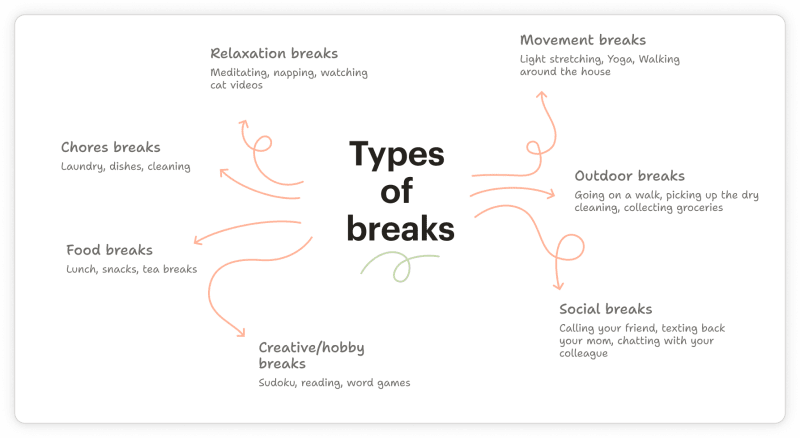
Based on research-recommended approaches, I’ve divided break activities into seven categories:
Movement breaks: Doing an easy stretch routine, walking around the house, and light yoga all classify as movement breaks. Movement is great for your body (especially if you have a desk job, like me), but it can also reduce post-lunch drowsiness and stress.
Outdoor breaks: Any change of scenery counts as a great break. It can be taking your dog to the park, picking up your dry cleaning, or simply soaking in the sunlight. Going outside for a quick break can improve your overall well-being, reduce mental fatigue, and enhance your focus.
Social breaks: Call a friend, chat with your colleague, text back your mom. All count as social breaks, as long as it’s not about work. Socializing can energize you and improve job performance.
Relaxation breaks: Take a nap, do some meditation, or watch cat videos. All these breaks will help you relax, reduce the cortisol stress hormone, and enhance cognitive performance.
Food breaks: Lunch and nutrient-rich snack breaks can help you recharge and gain more energy.
Creative/hobby breaks: Sudoku, word games, and reading can all help you recharge after doing an intensive task.
Chores break: Catch up on never-ending laundry, load the dishwasher, and change the bedsheets. Completing your chores in a break can boost your focus (and make your household duties more manageable).
Choose break activities based on:
How long your break is
What you help you recharge
What your mind and body need
For example, I often use my micro-breaks to run the washing machine and grab a snack. But during long breaks, I prefer to go outside for a walk or call a friend.
It’s handy to have a list of your favorite breaks in all the above categories so you can pick and choose whenever you’re tempted to scroll or waste your break on draining activities.
For Hailley, sitting outside to take a break does wonders for clearing her mind:
“Sitting outside is probably my favorite activity during a break. There's something about getting fresh air and being away from screens that helps me reset better than anything else. Even if it's just for five or ten minutes, stepping outside makes a real difference.”
Manasa also suggests choosing a break activity that will help you mentally disconnect from work:
“Breaks don’t just mean physically moving away from your computer but also logging off mentally to give your mind the space it needs to think, respond, and react clearly.”
But what happens when your mind can’t stop racing with work thoughts? Here’s what Hailley does:
“If I need to process thoughts or work through something, I'll record voice notes to myself. But if I need genuine rest, I'll put on an audiobook or podcast that has nothing to do with work. Something that lets my brain disconnect a bit and live in a fantasy realm.”
Ultimately, a break activity should be about disconnecting from work and connecting to something else. As Dr. Emily puts it:
“The best breaks aren’t about productivity, but about connection (to your body, your senses, or something that makes you feel human again).”
3. Schedule breaks in your calendar to follow through on them
The simplest way to ensure you take breaks throughout the workday is to add them to your daily schedule. For example, if you have a lunch break every day from 1PM, add that as a recurring task on Todoist.

Baking in breaks whenever you’re planning your day can also help you be more realistic about how much you’re hoping to achieve in a day. We often tend to overestimate how much energy we’ll actually have throughout the day. Adding breaks to our calendar can help match our workload to our energy.
When you integrate your Todoist with Google Calendar, for example, you can visually see where breaks can fit in.

The second way to make break-taking more sustainable is to design your systems in a way that:
Taking breaks becomes easy and inevitable
Returning to work after a break feels hassle-free
This can mean adjusting your meetings (if you have the freedom) to suit your breaks. For example, I often schedule meetings post lunch because I face inertia sitting back at work after the lunch hour. The meetings help me smoothly get back to work without overloading my brain.
Adjusting your environment also means identifying where you struggle with breaks and finding specific solutions to address them. For instance, I struggled to pull myself away from work to take a break for the longest time, until I got a physical timer and put it away in a different corner of the room. The act of physically getting up to turn it off helped me form the habit of taking a break when designated. You can use online timers, kitchen timers, or a sleek, minimalist timer (like the one I bought).
It’s also worthwhile to remember that breaks don’t always have to be loooong to be effective. If, on some days, you can’t afford to take a long break, even micro-breaks can do wonders. Hear it from Dr. Emily:
“It can be helpful to distinguish between micro-breaks and full exits from your workflow. You don’t always need to leave the zone entirely to get the benefits of rest. A break doesn’t have to mean a walk around the block or a 30-minute pause; it can be as simple as 90 seconds of stretching, a quick snack, or a text to a friend. These tiny resets can keep you grounded in your flow without tipping into burnout.”
Hailley has also found benefits in tiny breaks over powering through:
“If something unexpected pops up (like a last-minute meeting or one of the kids needing me) I’ll usually shift my break to after that moment instead of skipping it entirely. I’ve learned that even a few minutes of pause after something hectic can help me reset better than powering through.”
Once you start taking meaningful, effective breaks, the benefits will motivate you to keep going.
On the surface, it looks like breaks take time away from work. But once you dig deeper, you realize breaks actually give you back time that’s more focused, calm, and energetic.
You now have all the tools to build a break-taking system that works for you. Start by observing your energy patterns. Test different break ratios. Keep a list of recharge activities handy. Add breaks to your calendar like you would any other meeting.
The more consistently you take meaningful breaks, the more sustainable and satisfying your workdays will become.

Rochi Zalani
Rochi is a writer covering productivity, SaaS, and the freelance lifestyle.