
Todoist es el administrador de tareas nº 1 del mundo para organizar tu trabajo y tu vida. Quiero saber más
If you've ever ended a busy workday feeling like you didn't actually accomplish anything important, the problem might not be your work ethic. It might be your to-do list.
When your list is long and undefined (dozens of items all vying for attention), you end up in a constant state of triage. You respond to what's urgent. You work on whatever feels manageable in the moment.
But the meaningful work keeps getting pushed to tomorrow.
The 1-3-5 rule changes this pattern by encouraging you to be honest about what you can realistically accomplish today. It uses a simple structure to identify and prioritize what matters, while leaving room for everything else that needs to happen.
What is the 1-3-5 rule?
The 1-3-5 rule is a daily planning framework that structures your to-do list around three tiers of tasks:
1 big task: Your most essential work for the day (the achievement that will make the day feel successful)
3 medium tasks: Work that's important but not critical (less demanding than your large task)
5 small tasks: Quick wins that keep things running smoothly (tasks that don't take much time)
The rule was developed by Alexandra Cavoulacos, co-founder of The Muse. It first appeared in a Muse blog post, and it's detailed in her book with Kathryn Minshew, The New Rules of Work.
The method gained wide attention when Betty Liu, Executive Vice Chairman of the New York Stock Exchange, shared that she uses it every single day. "If I can tackle the big thing, I feel like I'm halfway there," Liu told Business Insider. "I have to say, it's been an amazing productivity booster."
The psychology behind the 1-3-5 rule
Much more than yet another productivity hack, the 1-3-5 method is rooted in several principles of psychology.
Why your current to-do list isn't working
The longer your to-do list gets, the more likely it is to overwhelm you. There you are, with 10, 20, or even 100 things to complete. And all of them seem both urgent and vaguely important.
Where do you even start? It's no wonder these lists create a sense of productivity anxiety.
Psychologist Barry Schwartz calls this the paradox of choice. As he explains, having too many options doesn't necessarily make you revel in your free will. Instead, it makes you anxious, dissatisfied, and hesitant to commit to any single choice.
This situation can easily play out in your to-do list. With so many options to consider, you spend mental energy deciding what to work on instead of doing the work.
If you're like me, you also second-guess whether you picked the right task. You might even get concerned that you made the wrong choice and end up starting another task in the middle of the first.
Either way, you feel guilty about the dozen things you didn't do, even though finishing all of them was never realistic.
How the 1-3-5 method helps
This productivity method helps reduce decision fatigue, manage expectations, and build momentum.
Every choice you make depletes your cognitive resources. In a 1998 research paper, R.F. Baumeister et al. suggest that as humans, we have limited capacity to process information and make decisions. Known as decision fatigue, this phenomenon compromises executive function and emotion regulation.
The cost isn't trivial. Research suggests that after an interruption or context switch, it can take up to 23 minutes to refocus on your original task. Over the course of a day, this can add up.
The 1-3-5 rule helps by front-loading those decisions. You choose your nine priorities the evening before. Then, you execute without having to think about what to work on next.
When you already have these nine tasks on your daily schedule, you can set more realistic expectations for yourself. Instead of thinking you might complete an entire project (and being disappointed when you don't), you'll know exactly what you're going to achieve at the start of the day.
As impactful as major tasks can be, they tend to be time-consuming. Completing small tasks helps create momentum and allows you to make progress on meaningful work.
This steady progress builds motivation, as Teresa Amabile and Steven Kramer explain in The Progress Principle. Essentially, these small wins help you do better work.
How to plan your day with the 1-3-5 rule
Here's how to implement the 1-3-5 rule, step by step.
Start with a weekly brain dump
Before you can plan tomorrow, you need to see the full picture of everything competing for your attention.
Set aside up to an hour for a weekly review and list everything on your mind. Don't organize yet. Just get it all out of your head and onto paper (or into your Todoist inbox).
Break down tasks by size
Next, sort your brain dump into three categories based on time and effort:
Big tasks typically take 2–4 hours of focused work:
Draft the Q1 budget proposal
Prepare slides for Friday's client presentation
Write the first section of a research report
Medium tasks usually take 30–60 minutes:
Review and provide feedback on a teammate's document
Research vendors for the office supply order
Prepare talking points for tomorrow's meeting
Small tasks take 5–15 minutes:
Respond to a colleague's question about next week's deadline
File an expense report
Send a meeting invite for next Tuesday
Be honest about how long things actually take, not how long you wish they'd take. If you're not sure, track your time for a few days to get realistic estimates.
Set up your daily 1-3-5 ritual
Each evening, create your 1-3-5 list for the day ahead.
Start with your big task. Look at your goals for the week or month and ask: What's the one thing that would make the biggest difference if I completed it tomorrow?
Then add your three medium tasks. These should support your bigger goals, but don't require the same sustained focus. Mix different types of work if possible to keep your day engaging.
Finally, add your five small tasks. Look for quick wins that help you make progress toward major goals (or just give you a sense of relief to have them off your list).
Complete your major task early in the day
Although you can certainly opt to eat the frog, your biggest task doesn't necessarily have to be the first thing you do.
However, Cavoulacos does recommend finishing it before lunch. This approach can reduce stress and help you feel accomplished before the day is even halfway over.
Review at the end of each day
Before you close your laptop, spend five minutes reviewing your day. First, check off all completed tasks. Then, decide what to do with anything you didn't get to.
For example, you might decide to prioritize unfinished tasks tomorrow. Alternatively, you might decide to put it back on your main list to revisit later. Or even delete it completely if it's not that important after all.
If your day gets completely derailed, don't wait until the end of the day to rethink your to-do list. Review your nine tasks and decide what to postpone. The point is making conscious choices about your time management instead of letting urgency make those choices for you.
How to use Todoist to manage the 1-3-5 method
The 1-3-5 rule works with any task management system, simple pen and paper will do the trick. But if you’re already using Todoist (or considering it), here are a few ways to optimize for 1-3-5.
Use task priorities to create your 1-3-5 structure
Todoist's priority system maps naturally to the 1-3-5 framework:
Priority 1 (red) for your one big task
Priority 2 (orange) for your three medium tasks
Priority 3 (blue) for your five small tasks
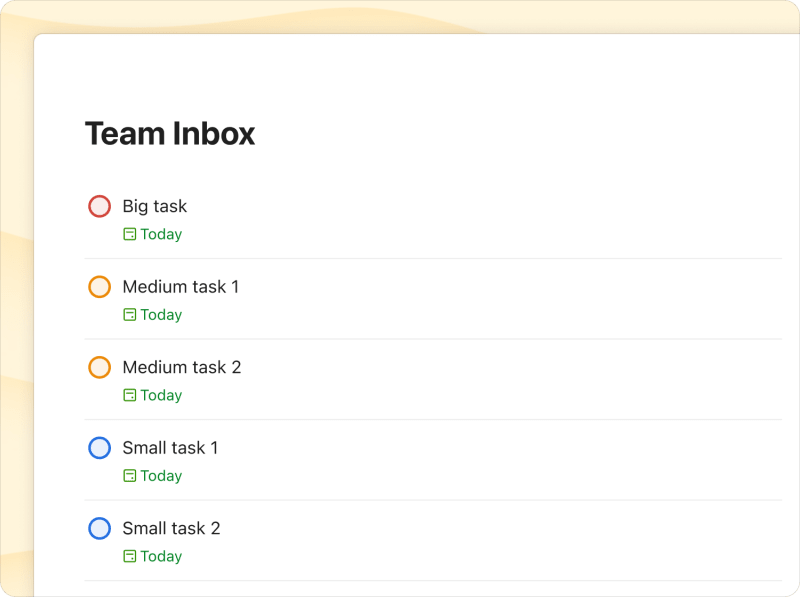
Whether you use the Today or Upcoming view, your highest priority tasks display near the top of the list. This makes it easy to know what to work on first.
Create a dedicated @135 label or section
Optionally, create a custom @135 label or project section. Or call it @focus or whatever resonates with you. Then, use it to keep track of your 1-3-5 tasks.
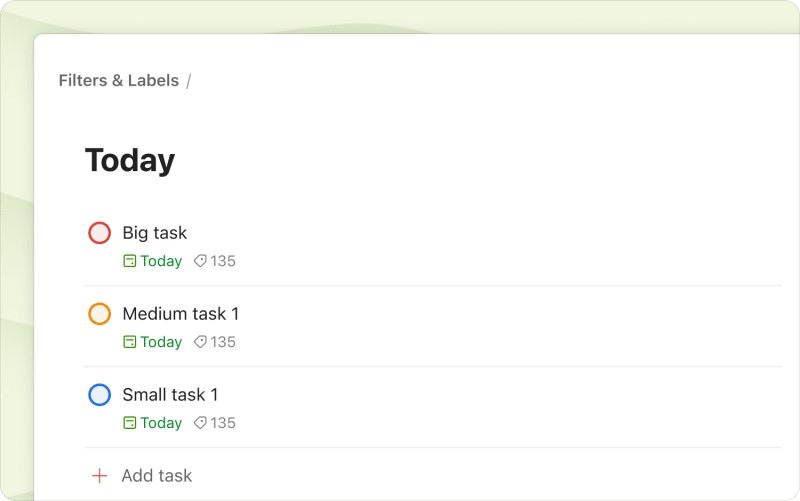
This becomes your focused view of what matters that day. Everything else in your inbox might be nice to do if you have time, but the @135 label or section represents your top priorities.
Set up a custom filter for your daily plan
Take the label approach one step further by creating a filter that shows you only the day's 1-3-5 tasks. Go to Filters & Labels in your sidebar, click the + icon, and create this filter: today & @135.
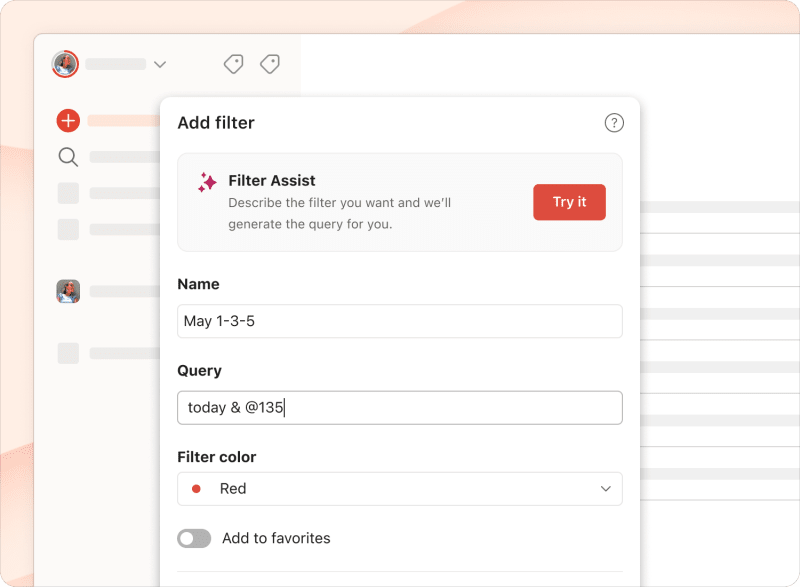
Name it "My 1-3-5" or "Today's Plan" and add it to your favorites for quick access. Now you have a view that shows you only your committed tasks for today, cutting through any other noise in your task list.
3 Ways to make the 1-3-5 method work for you
The basic framework is simple, but it's also highly flexible. Here are three adaptations that make the method more sustainable.
1. For flexible workloads: Time-block your big task
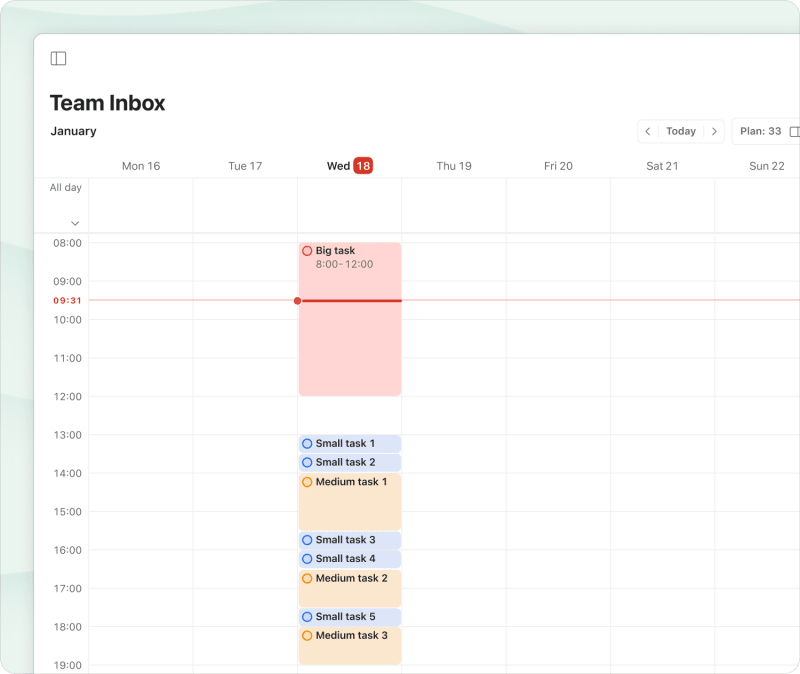
If your schedule varies day to day, the biggest threat to your 1-3-5 plan is that your big task never gets dedicated time. Meetings appear on your calendar, urgent requests arrive, and suddenly it's 4 p.m. and you haven't even started your most important work.
When you identify your big task, open your calendar and block 2–4 hours for it. Here's how time blocking works with Todoist's calendar view:
2. For team environments: Sync your 1-3-5 in shared projects
If you work with a team, sharing your 1-3-5 can create accountability and provide transparency. When everyone knows what other team members are prioritizing, you naturally reduce interruptions and improve collaboration.
Use Todoist's Team Workspaces to create a shared project. Then, encourage everyone to sync their daily 1-3-5 plan to keep everyone on the same page.
3. For energy-based planning: Match task size to your energy levels
Not all hours in the day are created equal. You know when you do your best thinking and when you get a second wind.
Instead of treating your 1-3-5 as a linear checklist, map your tasks to your energy level:
Peak energy hours: Big task
Mid-level energy: Medium tasks
Low energy: Small tasks
If you're not sure about your energy patterns, track them for a week. Every hour, rate your energy and focus on a scale of one to 10. Then, use the results to plan tasks in a way that helps you stay focused.
Signs you're using the 1-3-5 rule wrong
Like any productivity method, the 1-3-5 rule can be misapplied. Here are a few common mistakes and how to fix them.
Overscoping your tasks
Be realistic about what a task involves, especially for big tasks. For example, "Complete annual strategic plan" probably isn't a single task. Instead, it's a project that consists of multiple big, medium, and small tasks.
The fix: Break projects into tasks and schedule them across multiple days.
Ignoring the task size rule
The temptation is strong: "Well, I have a lot to get done this week, so I'll just do two big tasks today." But in reality, this is how you end up back in the land of overcommitment and unfinished work.
The fix: When you finish your work early, revisit your to-do list and see what else you can accomplish. Or take a break and recharge. But always plan one big task per day to avoid overwhelm.
Feeling guilty when you modify the rule
Maybe you had a day where you only needed two medium tasks, or a day where you had seven small tasks instead of five. That's fine. The 1-3-5 structure is a guideline, not a rigid rule.
The fix: Aim for 1-3-5 as your default, but give yourself permission to adjust based on the real demands of your day. What you shouldn't do is consistently plan for 1-3-15 or 2-5-8 and wonder why you're overwhelmed.
Neglecting to review or resetting each day
The method only works if you close the loop daily. If you let incomplete tasks pile up or if you don't make conscious choices about what moves to tomorrow, you just keep adding to an ever-growing list.
The fix: Set a recurring task in Todoist: "Daily 1-3-5 Review" at 4:30 p.m. or 8:00 p.m. or whenever works for your schedule. Make it as non-negotiable as a meeting with your boss.
The 1-3-5 rule doesn't promise you'll get more done. It helps you be more intentional about what you do.
By limiting your daily list to nine tasks, you reduce decision fatigue, set realistic expectations, and protect time for work that really matters. The structure is simple enough to adjust when your schedule changes, which means you can work with the method instead of abandoning it every time something unexpected happens.
What would your 1-3-5 list look like tomorrow? Start creating your list and planning more impactful work with Todoist.

Anna Sonnenberg
Anna Sonnenberg is a writer, editor, and strategist with over a decade of experience creating content for B2B SaaS companies like Agorapulse, Komodo, and Relato. As a seasoned freelancer managing a dynamic client roster, she's always testing productivity and time management tactics.